Baking Diary – Log 16 – 09.11.2012
This Tangzhong series intentionally includes two parts: The Universal Tangzhong Recipe Converting Formula and Examples. This is part 2/2.
Link to part 1, here.
—————————————————-
Hi guys, again,
As promised in the previous post, today’s post will be examples of how to use My Universal Tangzhong Recipe Converting Formula. Please read part 1 first before reading further below for better understanding of what I have to offer down here. 🙂 In summary, Part 1 contains introduction to the Tangzhong method (definitions and how it works), how to make tangzhong, and finally the theory of my universal tangzhong converting formula.
Now in the next parts below, the two examples I will give you are my two personal favorite bread recipes in my home kitchen, one white bread and one whole-wheat. They are both excellent recipes with great results every time. Moreover, they are super-duper versatile, yet very simple and convenient to make. They make great sandwiches and toasts with ham, salad, cheese slices, and jams, etc. or just simply butter. They also make yummy buns or rolls that suitable for breakfasts, lunches, or dinners! O.M.G! I could talk about them for hours, but let’s move on to the best part of this post. 😉
—————————————————-
Example 1 – My Daily White Soft Bread
This is super duper easy bread recipe that is suitable for beginners of bread baking. It was the first bread recipe I tried to bake a long time ago and still ranks very high in my recipe collection. I have written a post about it and how to make it in detail here, for your reference. 🙂

Daily white bread
Now, with a little magic dust of tangzhong it gets even better, so soft and moist, and fluffy. YAY! >D< It never survived in my kitchen for more than 2 days, but during that time, it stayed fresh and I bet it will be for longer time too.

Crumb shot
Original recipe
- 390g bread flour
- 235g warm water/ milk
- 12g fresh yeast (Note: I always prefer using fresh yeast in my baking, if you don’t have it in hand, use 6g dry yeast or 4g instant yeast)
- 1 ½ tsp. salt
- 50g sugar
- 28g soft butter, room temperature (or canola oil)
Converting process
- 5% of the total flour: 390 x 5% = 19.5g
- Final flour weight: 390 – 19.5 = 370.5g
- Tangzhong water weight: 19.5 x 5 = 97.5g
- Final water/liquid weight: 235 – 97.5 = 137.5g
- Total tangzhong weight: 19.5 + 97.5 = 117g
See how easy to use this formula is. 🙂 After this, we have the new tangzhong recipe as below.
Final Tangzhong White Bread Recipe
- 370.5g bread flour
- 137.5g warm water/milk
- 117g tangzhong (room temperature)
- 12g fresh yeast
- 1 ½ tsp. salt
- 50g sugar
- 28g soft butter, room temperature (or canola oil)
How to add tangzhong to your bread dough
Using tangzhong is very simple. First you cook it, and then cool it to room temperature before using it. When you incorporate tangzhong into the dough, simply add it in the earliest stage together with water/liquid and other ingredients stated in the recipe into dry flour.
—————————————————-
Example 2 – My Simple Whole-wheat Soft Bread
The following example is my favorite whole-wheat soft bread recipe, adapted with slight changes from here. It was SO good! I couldn’t believe it is whole-wheat. The texture was soft, and moist, plus the deep flavor and the health benefit of whole wheat. It is best of both worlds, already. HOWEVER, I felt that normal whole wheat bread seems a little dense and hardened the next day, therefore, I apply my universal converting formula onto this recipe, in other to keep all these awesome qualities for five days!

My fabulous whole-wheat bread
Best part yet, in this example, I will also bake my bread in a clay pot, the magical carriage of our Cinderella. 😉 Of course if you don’t have the clay pot like me, you can use normal bread pan for this recipe. I included the baking in clay pot method at the end of this post as bonuses for you, my dear readers and friends, so check it out.
Original recipe
- 235g warm water
- 10g fresh yeast (or 5g active dry, 3.5g instant yeast)
- 220g bread flour
- 150g whole wheat flour
- 50ml honey
- 6g salt
- 15g melted butter
Converting process
- 5% of the total flour: 370 x 5% = 18.5g (but let just take out the bread flour, not the whole wheat flour)
- Final bread flour weight: 220 – 18.5 = 201.5g
- Tangzhong water weight: 18.5 x 5 = 92.5g
- Final water/liquid weight: 235 – 92.5 = 142.5g
- Total tangzhong weight: 18.5 + 92.5 = 111g
Final Tangzhong Whole-wheat Bread Recipe
- 142.5g warm water
- 10g fresh yeast (or 5g active dry, 3.5g instant yeast)
- 201.5g bread flour
- 150g whole wheat flour
- 111g tangzhong
- 50ml honey
- 6g salt
- 15g melted butter
Because this is a pull-apart kind of recipe, I will include my savory filling recipe and demonstration here, for your references.
Savory Filling
- 100g mushroom (I used button kind), sliced + about 10g of butter for sautéing
- 200g minced meat + 5g canola oil, more or less for stir-frying
- 100g sweet corn (Both canned and fresh are OK), strained
- 100g sun-dried tomatoes, sliced to thin strips
- Spices (grounded black pepper, basil, etc. of your choice)
- Salt, sugar to taste
- 100g cheese of your choice (optional)
Simple egg wash
- 1 egg
- 2 tbsp. water or milk
- about 5 drops of oil or melted butter
Demonstration
Step 1: Make the tangzhong base on the instruction here in part 1 of this tangzhong series, let cool to room temperature before use.
One batch of tangzhong I mentioned in the universal formula is 50g flour : 250g water, equal 300g tangzhong made, in total. For this recipe, I use only 111g of tangzhong.
If you make bread everyday, make a large batch of tangzhong at once and use them up in 2-3 days. If you only make bread once in a while, measure the amount of flour and water to make enough tangzhong for that recipe only.

Ready-to-use tangzhong
Step 2: Dumb everything included in the Final Tangzhong Whole-wheat Bread Recipe above into a big mixing bowl. As said before, when you incorporate tangzhong into the dough, simply add it in the earliest stage together with water/liquid and other ingredients stated in the recipe. In this case, it basically means together with everything else. 😀

All ingredient at once
I can do this because I use fresh yeast; I can just crumble it all over and start mixing. Long live, fresh yeast! If you use other type of yeast, kindly activate it correctly according to the manufacturer’s instruction first before process with other ingredients.
Some bakers that are more careful and precise can leave the melted butter till the end when the dough of other ingredients has been fully mixed. I admit, I am a tad too lazy and the amount of butter in this recipe is small; therefore, I deliberately dumb everything at once. Excuse my laziness. 😉
Step 3: Start mixing on low speed for about 2 minutes until you achieve a cohesive, moist mass, like this.
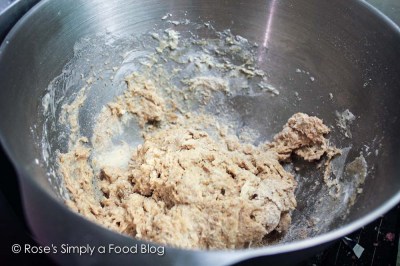
Mix until achieving this mass
Step 4: Increase the speed to medium. Mix for 7 minutes or more until the dough comes together, and starts slapping on the bowl’s wall.
The gluten development should be very high at this stage, meaning the dough can be stretched out to very thin sheet without being torn. Like this. See how wonderful the gluten has developed, now with the help of tangzhong?

See how well the gluten developed
Step 5: Form your dough into a ball, put it in a lightly oiled bowl. Now let it bulk ferments for approximately 1 hour, or until double in size.
Now that the dough is bulk fermenting, let’s prepare the clay pot and the savory filling.
Step 6: Here is my old, precious clay pot (that I could not bring back to Vietnam, and had to break up with it in Finland :(). You can see the shiny patina developed in the inside of the pot, indicated how often I used it, and how faithful it is to me…

My old clay pot
In order to bake with clay pot, you have to soak it in cool water for 15-20 minutes before actual baking. Reasons are explained below in the bonus parts.

Soak the clay pot in water
Step 7: After 15-20 minutes soaking, get the clay pot out, pat the inside and outside with a clean kitchen tower to absorb any visible excess water.
Line the pot with parchment paper, leave some extra for easier removing later, like below. This is to prevent the bread from sticking to the side, and linger it strong smell to the pot.
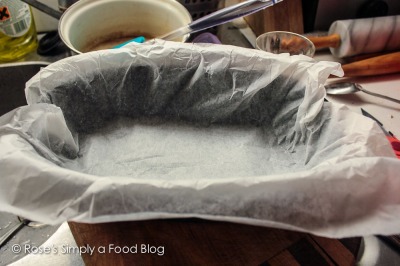
Line the pot with parchment paper
While waiting for the clay pot to get soaked, do not rest; continue with the filling making. Your hard work will be well rewarded. 🙂
Step 8: First sauté the mushroom in a pan with a cube of butter. To sauté, simply melted the butter in a preheated pan under medium heat. Add the mushroom, like below.

Sautée the mushrooms with some butter
Be careful not to crowd the mushrooms, or else they will not brown evenly (one interesting lesson learned from Julie & Julia movie ;)). Flip them halfway when one side is brown. Continue to sauté until both sides are like this picture.
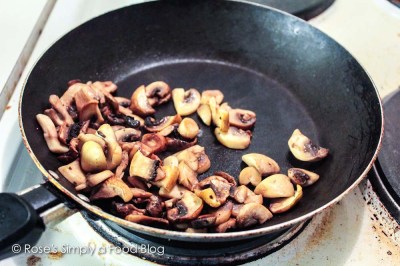
After sautéed
Put the sautéed mushrooms on a clean plate.
Step 9: In the same pan as before, add a little canola oil to stir fry the minced meat with the seasoning and spices of your choice, until almost done (80%).
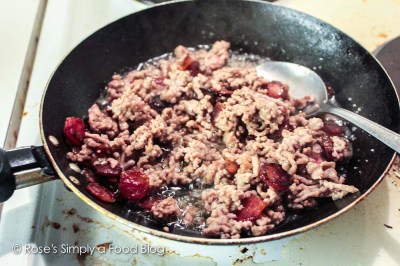
Stir-fry the mince meat
Step 10: Add the drained sweet corn, sliced sun-dried tomatoes, sautéed mushroom. Stir well until combine. Taste and add more salt if needed.

Add other ingredients
Now that your filling is done, let it cool down a bit before proceeding with the next step. You should plan your schedule quite precisely, dough bulk fermentation will take about 1 hour, clay pot soaking 15 minutes, filling making and cooling about 45 minutes, so every moment counts.
Step 11: At this step, what you should have is well-proofed dough, cooled filling, and a well-soaked, lined clay pot (if using any). Now, divide the dough in to 10 equal balls. Use a rolling pin to roll the ball into thin circle like below, top it with the 1/10 of the prepared filling. If you like cheese, it is time to sprinkle some on top your filling, also. Remember to keep the unprocessed balls under a plastic wrap to prevent skin drying. 🙂

Divided, rolled into thin circle, and filled with yummy filling
Fold the circle in half; use a fork (or your fingers) to tightly pinch the two edges together to form a pocket, like shown below.

Use a fork to seal the edges
Step 12: put your first pocket into the lined pot, with one side lying comfortably on the side of the pot. Continue with other balls; stack those pockets side by side.
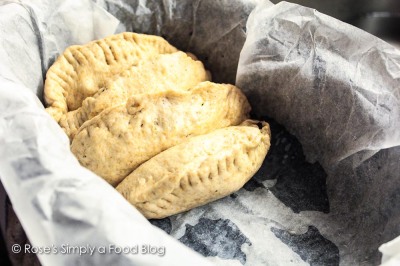
Start stacking them side by side
Here is what you are aiming for at the end of this step, a beautifully packed pot of whole-wheat heaven. 😀

Finish arranging the loaf
Step 13: Let the dough rise in the pot (with plastic covered or lid closed) for about 15 minutes more to almost double in size.
If you are using normal pan, let it rest for about 25-30 minutes, and preheat the oven to 180 degree Celsius. ONLY preheating when using a normal bread pan.
Step 14: Mix all the ingredient of the egg was thoroughly together; brush the top of the ready-to-bake dough evenly with this mix.

Brush with egg wash
Step 15: If you bake with clay pot like me, cover the loaf with the lid, put the loaf into in the COLD, UNPREHEAT oven, and then turn on the oven to 220 degree Celsius.

Remember to start baking in COLD oven and bake with the lid closed
If you bake with a normal bread pan, put the loaf, uncovered, into the preheated oven, and bake the loaf for approximately 30-35 minutes until the top is evenly and beautifully browned. If it browns too quickly, cover the top loosely with aluminum foil and continue baking until it’s done.
Arrange the rack to make sure that your loaf distances to the top and the bottom of the oven is equal, mine is on the lowest rack.
Step 16: (additional for clay pot bread baking) Because you bake your loaf in a clay pot, it will require more time to bake, about 10-15 minutes longer, or in recipe, for total baking time of 40-45 minutes. Bake the bread with the lit on for 30 minutes. After that, uncover the lit; reduce the temperature to 180 degree Celsius and bake for 10-15 minutes more until the top is evenly browned.
When the loaf is fully baked, get the pot out of the oven and place it on a wood or heat resistant trivet or potholder (fatally important, explained below). Remove the loaf immediately onto a cooling rack to prevent further cooking from the remaining heat of the clay pot.
Let it cool down for about 15 minutes before digging in. I know; waiting is a pain in the butt. >.< But it’s worth it.
15 minutes is up, and there you have it, one fabulously beautifully and super yummy whole-wheat savory pull-apart bread loaf. 🙂

My fabulous whole-wheat bread
Now tear those pockets away from each other… See how fluffy this whole-wheat bread is? Thanks to the tangzhong method, plus a little help of the clay pot. 😉
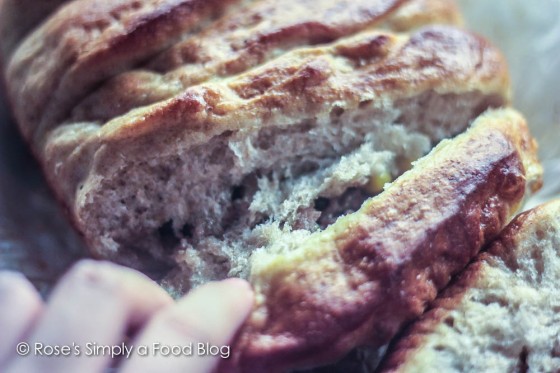
See how fluffy and moist it is? Wonderful!
Not only the bread was very soft and moist, but also the filling was well seasoned.

My fabulous whole-wheat bread
The other half did not survive long after, as it was devoured the next morning… 😛 And you know what, the next day, it was still soft, and moist, as it was the day before! (Not as warm, of course ;))

My fabulous whole-wheat bread
—————————————————-
Bonuses of today’s post
As bonuses, I will explain how to bake bread using a clay pot. Baking Clay pot helps your bread raise better since clay is a great heat reserving material and it has lid that capture the precious steam but still, porous enough to absorb some moisture and not return it to the surface of the loaf; making soft bread even softer and moister, or creating the most beautiful, artisan-looking hard-crust bread. I do not invent these knowledge but rather referring it from other trustworthy sources.
Bonus 1 – Summary on How to bake in Clay pots (References: here and here)
Step 1: Soak the clay pot in cold water for 15 minutes. This helps to seal the pores of the clay and allows the pot to steam during the baking process. Although it is not necessary to soak every kind of covered clay pot before baking, Römertopf (one of the most popular choice in clay pot) recommends this step for theirs, so please check with your clay pot producers.
Step 2: Prepare your bread recipe according to directions. When the dough is ready for the second rise, shape it into loaves or balls that fit the clay pots. Get the pot out of water and drain the top and bottom and pat the insides dry.
Step 3: Cut pieces of parchment paper to fit the bottom and sides of the pot. The sides should be tall enough to grip and easily lift out the baked loaf. Then arrange the dough into the clay pot. Do not fill the pot more than half full, to allow for additional rising, known as the oven spring. (Quite much, so beware!)
Step 4: Cover the pot with its lit. Place the clay pots into a COLD oven once the dough has almost doubled in the pot. Never ever put a clay pot in a pre-heated oven because it will crack from the shock of the heat.
NOTE: Remember to reduce about 10 minutes of the second rise, e.g. if the if the normal procedure calls for 45 minutes; decrease it to about 35 when baking with clay pot since we will bake in cold oven, there will be more time for the dough to complete its second rise.
Step 5: Set the oven temperature to 40 degree Celsius higher than the bread recipe calls for, for instance, if the normal procedure calls for 180; increase it to about 220 when baking with clay pot.
Step 6: Bake the bread for 10 to 15 minutes longer than called for in the recipe. Because you are starting with a cold oven, bread baked in a clay pot takes a few minutes longer than if baked in metal or glass.
Step 7: In the last 10-15 minutes of baking, remove the lid, reduce the temperature to the level stated in the normal recipe, and bake uncovered for another 10-15 minutes, or until the crust is brown.
Step 8: Remove the baked bread immediately from the clay pots after baking, as the pot will continue to cook the bread with its absorbed heat even after it is removed from the oven.
NOTE: Do not place a hot clay pot on a cold or cool surface, as it will crack, creating a disaster in your kitchen. So when taking a hot pot out of the oven, always place on a wood or heat resistant trivet or potholder. Use the edges of the parchment lining to lift the loaf out of the pot and set aside to cool. Then enjoy!
Bonus 2 – What Else to Cook in Clay Pots (References: here or here)
There are various other types of dishes are particularly well suited to clay pot cooking. Below are just some examples:
- Vegetable ragouts and ratatouille
- Baked potatoes
- Whole chickens, Cornish hens, and ducks, along with vegetables
- Meatloaf
- Baked ziti or lasagna
- Stews and casseroles
- Baked cheese, such as feta, with olives and fresh oregano
- Bread puddings, Fruit cobblers
NOTE 1: Clay pots should not be used on top of the stove, unless stated otherwise by the manufacturers.
NOTE 2: Clay pot cooking does not require added fats. The use of added fats (usually butter) only as a seasoning to boost the flavor, so if you’re looking to reduce fat or calories, you can easily leave it out.
NOTE 3: Add liquids sparingly, as any food you’re cooking will throw off liquids of their own (especially fruit, vegetable, and meat) and you don’t want the pot or the dish to overflow with excess liquid.
NOTE 4: If you cook fish or any other strong-flavored ingredients like garlic or onion, either line the pot with parchment paper or give your pot extra soaking time afterwards or else the flavors will be absorbed into the porous clay, then it will be very hard to remove and may linger to other dish cooked in that pot in the future.
Bonus 3 – How to Clean the Pot and Take Good Care of It (References: here)
DO NOT wash a clay pot with soap or detergent because the porous clay will absorb the soap. Instead wash with warm water, using a brush and baking soda to help remove any baked-on food. While some say it’s okay to put in a dishwasher, most machines’ high temperatures and harsh detergents may damage a clay pot.
If you don’t use your clay pot often like me and there is any mold formed during long storage periods, just rinse with warm water and use a brush with baking soda to remove the mold. Again, no soap, please!
NOTE 5: Over time and with frequent use, your clay pot will darken, retaining scorch marks and stains but developing an appealing patina. Patina is good thing, not some kind of mold or charcoal; so don’t try to scrub it out!
NOTE 6: For most home kitchens, a 1.5-liter covered clay pot is quite useful, it will easily hold a 3 to 5 pound chicken, plus vegetables or a daily loaf of bread, and costs about $35. If you want to use your pots for both savory and sweet dishes and you have the storage space, you may want to invest in two pots so that any absorbed flavors won’t affect the taste of your recipe.
If you have any comments or questions concerning my tangzhong converting formula, please don’t hesitate to leave a word; I will try to be as helpful as possible.
OK, it is almost it for today. It is officially now 3am in Vietnam, and my class starts at 8am. 😛 So good morning from Vietnam, guys. And see you soon in another posts.
Rose,
P/s: I submitted this to YeastSpotting.
 Simply a Food Blog
Pingback: Bread-making Basics: A Rudimentary Take – the last word
Hi! I’m really fascinated with this method. What’s your advice for conversations on enriched doughs?
LikeLike
Pingback: The Most Amazing Tangzhong Chelsea Buns | Patisserie Makes Perfect
Hi! Can I use the savory filling for the meat pies and the whole bread loaf using your 100% wheat tangzhong bread instead of just the wheat tangzhong bread like you used here or will there be complications or problems? Let me know if I might need to make adjustments?
By the way, have you ever tried making a tangzhong einkorn or spelt loaf? I was just curious to see if it worked or not. Thanks!
LikeLike
Hi Rose, I’m trying the tangzhong white bread and waiting the bulk fermentation right now. Just wondering my dough didn’t feel sticky at all. I followed the recipe to the tee. Do you think maybe I should’ve asked a little more water? Can’t wait to see how it turns out. I haven’t had much luck with making breads 😫.
LikeLike
Hi Helen, how did the bread turn out? I hope you had it nailed. 🙂
The tangzhong dough is not necessary sticky, it all depends on the initial bread recipe whether it was a high water percentage recipe. Have you ever made the bread without the tangzhong conversion? How was it then?
Let me know so that I can be more helpful to you.
Rose.
LikeLike
I’ve been expecting your response 😊, thanks so much. It turned out pretty good. I did hope the bread would stay fresh for days as I used the tangzhong method but it turned pretty hard the next day and even harder the day after. And I used additional product to make the soft bread. It still turned hard after a day.
Rose, do you know how I can adapt the recipe to incorporate eggs into the tangzhong bread recipe you have? I thought of adding egg yolks. Sorry for the long email. Appreciated your response and feeling lucky to have found your site. I really want to be able to make fluffy airy breads. Helen.
LikeLike
Hi Helen, good to hear back from you. There’re several factors affecting bread storing ability, namely: climate (is it dry or humid in your area?), how you wrap (best is to use brown paper to cover the whole unused bread or for soft bread put it into plastic bag and seal it with rubber band). How did you store your bread? Though tangzhong does help lengthen the bread life, it’s not magic if you don’t store your bread the right way.
Let me know,
Rose.
LikeLike
Ooh, and for the egg addition you asked. Unless there are eggs in the original recipe, don’t mess with the bread percentage and ingredients. If there are eggs in the original recipe, there’s a section in the conversion formula for that I believe, pls read and feel free to call out for more info. 🙂
LikeLike
Hi Rose,
I am looking forward to trying out your receipe for white bread with tangzhong. Which ingredients/combinations do you find the best for a light, fluffy texture:-
The tangzhong: water or milk or part water/part milk?
The main ingredients:- water or milk or part water/part milk?
butter or oil?
Which gives the fluffiest texture: using an open loaf tin in the oven;
covering the loaf tin;
using a clay pot with lid.
Many thanks,
Alison
LikeLike
Hi Alison, I suggest you start with your favorite normal white bread recipe, whatever ingredients or tin. Have a good base recipe is the key because tangzhong is a method to enhance the qualities that are already there. 🙂
But in general, to answer your concern:
– Water lighter than milk
– Milk more flavorful, softer than water
– Butter more flavorful than oil
– Oil can only replace melted butter in a recipe, not cold nor soft room temperature butter
– Open tin results more airy bread than loaf tin
– Claypot baking? The best! But remember to soak the claypot to support more moisture to your bread.
Hope this helps and hope to hear back from ya.
Rose.
LikeLike
Thank you Rose.
Alison
LikeLike
Hi Rose, How much warm water should I use to active 6g of dry yeast ?
LikeLike
Hi SK, I suggest using at least 5-6 times the amount of yeast you try to activate, e.g. ~30-40g. But I don’t think it matters as long as you remember to deduct the amount of warm water used from the total amount of water in the dough recipe.
Hope it helps,
Rose.
LikeLike
Greetings from Minnesota, I’m so glad i found this posting. I have found it to be very informative and very useful. Being we use cups and ounces for measuring, is there a way to figure this conversion for the flour and water or would it be best to convert the recipes to metric?
Also, would it work to add the Tangzhong to a pizza dough?
Thank you
Ryan
LikeLike
Hi Ryan,
This converting formula works best with weight metrics. So I know it would be an extra length to convert cups into grams but it will be worth it with tangzhong magic.
As for the pizza dough, the tangzhong method works with almost every bread recipe, as long as your core purpose is to have fluffier, longer lasting bread. 🙂
Hope it helps,
Rose.
LikeLike
Pingback: Totoro Pull-apart Bread (Tangzhong method) – oliversmile
Dear Rose,
Greetings from Greece. Thank you for your blog. I am just trying your tangzhong recipe and I added it in my bread recipe of the day. According to your instructions I reduced the water of my recipe, which was reduced by about 50%. This caused the dough to be a bit dry. Is it supposed to be so dry? Should I add extra liquid? Please specify as soon as you might possible can. Thank you in advance.
Ersi
LikeLike
Pingback: Totoro Pull-apart Bread (Tangzhong method) - oliversmile
Hi Rose Great blog u have here. Do u have a simple tangzhong bread recipe that uses a 18x11x11cm Pullman tin? Thanks in advance! – marg
LikeLike
Hi Marg,
Sorry I don’t have one at hand right now for that specific Pullman size, usually I used my white bread recipe as staple bread. 🙂 You might be interested in having a look here: https://simplyafoodblog.wordpress.com/2012/11/05/revealing-the-ultimate-secret-to-softer-fluffier-bread-that-stays-fresh-for-days-part-1-my-universal-tangzhong-converting-formula/ where I try to explain my converting formula with the recipe.
Hope it helps and let me know if you have further question,
Rose.
LikeLike
hi rose, thanks for your blog! I would like to ask if my breadmachine call for say 200ml of water, do I weigh the water & deduct the tangzhong portion?
LikeLike
Hi Dina, yes, you would have to reduce the amount of water used for the tangzhong, let say out of 200 g originally stated in the recipe, you used 90g for tangzhong already, then you would only add 110g water more.
Am I making sense?☺️
Rose
LikeLike
Hi Rose,
My recipe calls for 200ml of water not in grams, so do I weigh 200ml of water get the weight then deduct accordingly? Thanks dear!
LikeLike
Hi Dina, 1ml of water equals to 1g of it. So easy to convert between those 2. Hope it help. ^^
LikeLike
Hello Rose, I was wondering about making your white bread recipe more of a sweet bread by adding eggs and honey? Also what about adding some instant potato flakes? Your thoughts and measurements would be greatly appreciated! Thank you!
LikeLike
Hi Mary,
I wouldn’t recommend altering a recipe, instead, you could try this challah recipe on Allrecipe that I found very dependable to produce good result:
– 295 ml warm water
– 6 g active dry yeast
– 60 ml honey
– 30 ml vegetable oil
– 1-1/2 eggs
– 9 g salt
– 500 g unbleached all-purpose flour
Of course you can give this one a tangzhong twist with my formula too.
Hope it help and let me know how it turns out. 🙂
Rose.
LikeLike
Would you care to convert it for me. I would greatly appreciate it…conversions are a little over my pea brain:) Thank you!
LikeLike
Pingback: Week 2: Cinnamon walnut and chocolate roll | The Baking Hermit
Pingback: Sweet Coconut Bun with Tangzhong - Chindian Kitchen
Dear Rose
Very interesting site you have here. Thanks for the convertion to do tangzhong method for other recipes. Just discovered this method and my family loves the soft bread even after few days.
Just need to know that if my weighing machine do not have decimal point how do I convert the flour 201.5gm without decimal point. Please advice. Hope to hear from you soon.
Thanks
Amy
LikeLike
Hi Amy,
I hope you don’t surprise that I answer this soon, I am writing a new post, upon reading your comment.
First, thanks for trying out my formula and I am glad that your family enjoy homemade fresh bread. They are just the best, ain’t they? 🙂
Second, as for the weight, you don’t have to be too strict on the decimal there. Sure, baking is a science, but it should be fun and relaxing as well. So don’t worry to add a tiny 0.5g to ease your process. Because the percentage of flour and water in a bread recipe is usually large enough to tolerate such small deviation.
Hope this helps,
Rose.
LikeLike
Dear Rose
Thanks for your answer. Yes we always prefer homemake bread just that normally after the next day the bread will not be soft but this method helps it to stay soft for few days. Okay I will then convert it to round figure. 🙂
Have a nice week day ahead!
LikeLike
Pingback: 100% Whole-wheat Bread – Weekend Fun with Tangzhong & Semi-Autolyse Method | Simply a Food Blog
Hi Rose, having problems getting my 100% whole wheat bread to get a good rise so I get a soft full loaf. Will this method help?
LikeLike
Hi Chesty,
Tangzhong significantly help in producing softer loaf. So I suggest you give it a try, but I think you should make tangzhong with white flour.
Another way to make softer 100% whole wheat bread with higher rise it to soak the flour with 3/4 of the water, no salt, no yeast, no sugar, nothing, just water + flour for 30 minutes up to 2 hours before incorporate other ingredients into the dough and knead. Like this: http://myhealthygreenfamily.com/blog/wordpress/100-whole-wheat-sandwich-bread-recipe-that-rises-like-white/
I think if you combine the soaking + tangzhong together, it would be a great success.
Hope this help and keep me updated,
Rose,
LikeLike
Hi rose,
I just came upon your site and am excited to try the tangzhong method to make bread stay soft longer. I wanted to try your whole wheat bread recipe you linked above. Im wondering how do you combine the soaking + tangzhong method? Where do you compute for the % of flour and water for the tangzhong method? Is it still from the total of flour/water? But how do i know how much i needed to soak? Is it still the same as you state in your recipe?
And can i use instant yeast? If so, do i need to activate it or i can just mix the yeast with the rest of the ingr?
As for your white bread/tangzhong method, is it ok to use all purpose flour instead of bread flour? Will i achieve the same outcome?
I hope you can answer my questions. I very much want to try your recipes. Thanks
LikeLike
Hi My,
Glad to see you here and enjoy what u saw.
I would suggest you first follow my recipes to a T and see how they turn out, no modification of methods (soaking) or flours (All purpose), only then you can see if my conversion method really working as I claim, right? 🙂
Instant yeast is fine, btw, no need to activate it in advance to add to your tangzhong dough.
Hope it helps and hear from you soon!
Rose.
LikeLike
Hello rose,
I made your white bread into rolls using the tangzhong method yesterday. It was indeed very soft on the day i bake them. Today (2nd day), its still soft, but not as soft as the 1st day. I hope it will not harden as the days passed. I used all purpose flour instead of bread flour and instant yeast. I could send you he pic if you want to see it ü
LikeLike
Hi My, glad to hear that the tangzhong method „somewhat“ worked out for you. ^^ If u don’t want it to harden up, remember to wrap it tightly in plastic bag. And pls send pics over, I would love to have a look!
Take care,
Rose.
LikeLike
Je ne suis pas certain, mais je pense qu’il y une erreur pour le poids :
I’m not sure but I think it’s 117g in lieu of 137.5 g . Right ??
370.5g bread flour
137.5g warm water/milk
137.5g tangzhong (room temperature) ( may be 117g ) HERE
12g fresh yeast
1 ½ tsp. salt
50g sugar
28g soft butter, room temperature (or canola oil)
Merci encore pour cette recette. Thanks again for your recipe.
Hervé ( Grasse, South of France )
LikeLike
Dear Hervé,
You are correct. I change the number. Thank you so much for your notice.
Rose,
LikeLike
Hello Rose,
Thank you for your excellent blog, very clear instructions and useful tips!
I have a general problem/question, which became even more clear when trying your “brioche obsession” recipe. Perhaps you can help figure out what I’m doing wrong?
I use a bread machine to make different kinds of bread. All the breads & brioche come out OK – but not more. In particular, while they do rise reasonably (close to 2x), they never “burst” out of the pan, no matter what the recipe. Absolutely no “oven kick/spring” during the initial cooking period. It NEVER looks like the photos on the blogs where I find the recipes 😉
When I tried your brioche recipe, I noticed something really odd (once cooked and sliced): the dough inside expands well (fluffy – thank you tangzhong!), the load does rises 2x, but not more – instead it “expands”. What I mean by this is the bottom and sides of the loaf become highly compressed, thick (1.5 inch of dense product, but crust thickness is thin & normal), and generally unpleasant as a bread, while the core and top of the loaf are perfectly fine and fluffy. It’s as if the dough could not lift itself out of the pan, only exercise radial pressure. It’s less visible on regular bread because the dough is generally more dense, but on the tangzhong brioche with a very fluffy core, it was very visible to the eye.
I’m struggling to identify the root cause. I measure the ingredients by weight using a proper scale, I estimate the humidity to make sure there is enough water in all recipes, all my ingredients are at room temperature (Bangkok – warm), I use bread flour and recently purchased yeast, etc. Water and/or milk are brought at room temperature, or even warmed up a bit if making enriched dough containing butter/eggs. I use inverted sugar (from my sorbet recipes; I read that professionals prefer that to regular castor sugar for bread making)
I even go to the point of removing the dough after the first rise/punch down, to remove the bread machine hooks, shape the dough into a nice ball, and put it back for final rise (this has a surprisingly major impact on the outcome – it seems dough in a bread machine has difficulty “moving around” to settle into the pan evenly, because the hooks and knobs interfere with the dough expansion. After shaping the dough evenly, it rises much better – but still absolutely no oven kick)
This leaves me with A) the question of bread machine temperature – but the bread comes out with a normal crust thickness, normal crust color, baked inside not more/less, etc. I can’t fault the temperature in any obvious way. Or B) the question of proofing duration. Perhaps the machine starts baking too early? I don’t believe so – the 2nd rise is holding steady and not rising much more by the time the baking starts. It’s the oven kick that is not happening in my opinion (dough doesn’t visibly collapse during 2nd rise or baking phase).
I’m really puzzled and frustrated, especially after seeing the photos of your tangzhong bread. I was all excited after reading your blog, and now my family is making fun of me 😉
LikeLike
Hi Gus,
Thank you for your kind support, and very detailed case of question.
Sorry it took me quite long to reply, I have been busy with a project at work these past few weeks. So here is my 2cent. I suspect the problem can be caused by 3 factors:
1) too much dough for the pan to handle: in your case of heavy, dense 1.5 inch thick crush. You might have notice that tangzhong bread rose much nicer, and bigger than normal bread. So if you making tangzhong bread, please make sure that there is enough space for the dough to rise. have you tried baking the loaf free form (I mean in buns, or rolls) or in bigger pan or with smaller amount of dough?
2) bread machine temperature. I notice this when I changed from my old oven in Finland to my new one in Vietnam. Each oven behaves differently, some has extremely hot under, some above. Some even 20degree C different from their indicator. You have to check it very carefully if your machine is well calibrated, or if there is a hot spot there. If your bread doesn’t rise much while baking, how about you bake them at a tad lower temp. for first 15 mins, then increase to normal for the rest of baking time?
3) Yeast activation, yes, I saw your mentioning using recently bought yeast. But sometimes, I have the same problem here in Vietnam. You have to make sure that you activate the yeast to their most alive before adding them to the dough, because I saw you mentioned that you might have rising problem in the 2nd proof. Active dry can be add directly, dry yeast has to be dissolve in warm liquid for about 5-10 mins (if you see them foamed up vigorously, they are alive and well), fresh yeast is a bit more tricky, I have always add them directly to my dough (which warm liquid is added), but some recommend treating them like dry yeast. Please check you yeast again just to be sure. And in 2nd rise, the dough needs to rise double before baking. If this is not your case, let it rise a little longer.
Hope this help with your case. And don’t worry of your family making fun of you. You are doing a good job, and are willing to learn more! Keep me updated plz.
Good luck in the oven,
Rose,
LikeLike
Thank you Rose. Quick comments and additional info:
– never thought of volume of dough vs pan. The quantity I’m making is reasonable based on the machine specs, but that is nevertheless definitely an idea I haven’t tried – and that makes sense! Thanks.
– temperature: I cannot set this in the bread machine. I’ll try do some temp measurements, and optionally try in a conventional oven where I can set it. Good idea!
– yeast: I just bought a different brand of yeast, and to my great surprise made 2 x perfect 400g loaves of french bread in my regular oven (not baguette, more like “pain”). Came out perfect, first time in my life I tried. Obviously it was pure luck, but I suspect the new yeast had to do something with it, as it was rising very nicely, as described in recipes. I need to try the brioche with this new yeast, perhaps I had a stale batch of individual packets???
– On another blog, someone suggested I use a sweet-dough program, rather than the milk-bread program I was using. Proving times turned out very different, and the brioche came out significantly better! Still no over-kick, but certainly a lot fluffier all around.
==> Will keep trying, and hopefully post a nice photo when I’m successful.
Best regards from Bangkok
Gus
LikeLike
Hi Gus,
To continue our discussion…
3) Yeast: can be tricky as it is lively bacteria, not purely chemical like baking powder or tartar. 🙂 I just remember that I never had problem with fresh yeast but with dry yeast, sometimes things went weird. I don’t know about BKK, but in Vietnam, there is 2 type of dry yeast for professional, sweet/enriched (with sugar more than 20%) dough and plain dough (with sugar less than 20%). They behave differently depending on your dough, so if you use plain-dough yeast for enriched bread, oh no, not a good day to bake. 😦 Been there, done that. So, maybe your old yeast is not stale, it just not compatible. If you try out new yeast and have positive result, why not give it a try in the brioche? 🙂
– The other blogger is absolutely right, I never had a bread machine, so I don’t really know how it works. But it is true that sweet, enriched dough like brioche or croissant take mucccccccchhh longer to proof than normal milk dough. 😀 my croissants usually take a sweet 3.5h to do its magic. Brioche takes about 3h.
Cannot wait to hear from you, Gus.
Rose,
LikeLike
Hi rose!
Done. I just bookmarked this page.
You don’t know how I am THRILLED reading this post! THANK YOU THANK YOU SOOO MUCH for sharing this..I mean I know “some people” who would share something like this with a hand of money..but you Rose is exceptionally passionate on this.
Every single detail is there so what might go wrong right. I’m soooo LOVING YOUR BLOG! THERE IM OFFICIALY ONE OF YOUR FAN.
I’m from the Philippines yep an asian haha..
but in my exact location it saddened me to see a lot of bakeries who havent had that “texture” and moist in a bread I’ve always wanted. Ive taste once but its in the city ~ since then ive searched in my home town but to where I am, its a very small town who cant afford to make a cafe or coffe shops. theres none here. I wanted to build one but I need more skills and knowledge in baking. 😉
I love making cupcakes, brownies, muffin and cookies. Fudgee, gooey, and moist cupcakes are my best so last month my family made me decide to make it a small business, but this week I wanted to try DOUGHNUTS.
Rose, can you please help me with this. I am new in baking bread and I just want my doughnuts to somehow be apart from other doughnut stand here I wanted it to be moist. Can the tangzhong will work as well in doughnuts because it is deep fried right. I was in the middle of Googling what steps or technique should I do to accomplish that texture you’ve been telling on this post. I will probably stay late today because I want to read more of your posts so it can help me on learning all about breadmaking.
Thank you so much!
much love
pearly
LikeLike
Hi Pearly,
Thank you for your kind and passionate support on my blog. 🙂 Very much appreciate it!
About the doughnut, I think there are 2 kinds of doughnut, baked and fried. If you want to make the fried, you hit the right spot. Because this tangzhong formula is very universal, you can use it in almost any bread recipe that you prefer to be softer and fluffier.
I don’t particularly have any specific doughnut recipe, but I think one of many way to make your doughnut special is to add some spicy edges to it, e.g. nutmeg, cinnamon, five-spices, chilli or curry if you want to go extreme. 🙂 You can add it in the dough directly (recommended for the baked kind) or you can develop a dipping recipe of your own.
One more thing that can make your doughnut special is to try adding more complex ingredients in the dough, e.g. carrot (plus some cinnamon, yum), zucchini, coconut, lemon zest…. the combinations are countless. Just as you are making cupcakes.
Hope this can help can cannot wait to hear more about your results.
from Vietnam with hugs,
Rose,
LikeLike
Rose! If you were in the room with me right now I would kiss you!
If you cannot tell already, I am jumping with joy here – the loaves – both white and wholemeal – came out absolutely wonderful!
A bit of background.
The price of quality food in New Zealand has gone stupid right across the food groups.
A quality, healthy, wholegrain loaf of bread costs between $5 – $8, so you can imagine how much it would cost you to buy a weeks worth of that type of bread.
We end up stocking up on this cheap loaf for $2, and it is rubbish! It has no sustenance. I need two salad filled sandwiches of that bread to keep me going for the afternoon as opposed to one sandwich of the quality loaf.
I am one those people who will make something if I cannot afford to buy it, and healthy bread is definately one of those foods that no one should go without, so I decided “that’s it!, The bread my family eats will be homebaked from now on!”
I have tried making a few loaves and every single one of them came out with cake texture and crumb.
I tried different brands of flour – no good.
Longer kneading time – no good.
Varied the time for the dough to rise – no good.
Frustrated with the waste of ingredients, money and time, I came onto the internet to see if it is actually, at all possible, to bake a loaf of bread at home that comes out like a brought one.
I thought to myself that there must be a particular ingredient that professional bakers use in their mixes that home bakers cannot get that makes the bread so chewy and soft and delicous.
I came across other sites that advocated weighing the ingredients as opposed to measuring in cup form. I took note.
Then another site that got way too complicated with the type of flour verses the oven temperature, kneading and rise time . . . (blaaaaaaaaaaah!).
Then . . . I found yours, which looked straight forward enough, and you measured ingrediants via weight was along the lines of the first blog I looked at, so I gave the white bread a go – and WELLA! The best bread I have EVER produced!
My partner loved it, my three year old enjoys it – YAY!
Then I tried the wholemeal – yet again another satisfactory result.
Now that I have achieved those two recipes I am going to adapt them and add lots of healthy grains and whatever else I can throw in to boost the health factor for my family.
Rose, thank you, thank you, thank you, for sharing this with us all – you are a saint!
Biggest of hugs all the way from New Zealand xxxxx
LikeLike
W.O.W!! I was more than thrilled, and getting more and more excited as I read your comment. Congrats on your new, great conquer in baking. Our families deserve only the best, don’t they? 🙂
And you are more than welcome, Trina. I was so flattered coming to the end of your comment, that I actually blushed and giggling for the whole day. :”> I thank you so much for your kind words.
Hope we keep in close touch with each other’s kitchen. 🙂 I will blog again real soon, so see you.
Hugs and kisses back from Vietnam,
Rose,
LikeLike
HI Rose, I am so very happy to chance on your blog. Am very interested in bread baking and both this and the earlier posts show how much of thorough work and thought has gone into this technique and hence inspire a great amount of trust.
Even more, I feel so very glad to meet a kindered soul! I don’t have your precise approach to baking or patisserie but I do feel that science is an important part of all baking and definitely understand what you feel about wanting a life around creating food because your soul cries out for it. I just tossed a decade long lucrative career in design to work out where I want to go with food. While my husband is the one who inspires faith in me and helps me keep faith in myself, I do sometimes miss the regular paycheque and get worried or worse, fear. My worst fear is that I will one day regret the decision and lose my passion for food which is the most precious thing for me. I also have to admit it, I fear failure. However, on any given today if you ask me if so far I have ever had a moment of regret, I can confidently tell you I dont. The past year, despite its challenges has been one of the happiest for me. And reading your most helped me remember why I am doing this.
Hugs, best wishes and strength to you 🙂 I know you will go a very very long way because you are clearly very talented. But what’s even more important, enjoy it and never look back with anything except pride and joy that you took the path you took.
LikeLike
Hi Bombay Chowparty,
I am grateful for your sincere encouragement, and am more than thrilled to make a connection with a new, wonderful friend like you. 🙂
I am doing well in every way, except for one… I think I might not be able to be part of the professional baking industry here in Vietnam since we have a whole different standard in baking, plus the definition and importance, as well of people’s respect of Western baking is not in a level where I want to be in. 😦 I am weakened, mostly mentally. But, there is one thing life cannot take away from us. It is passion, isn’t it? I intend to devote in food blogging and make my way from here. If I cannot be a great baker, at least, I can be a great blogger, can’t I?
I will blog again soon. So see you, somewhere, sometimes, in this small world.
Hugs and kisses from Vietnam,
Rose,
LikeLike
People question and doubt us because they don’t understand or don’t have the same vision. Don’t let them bring you down! As another commenter said, your talent is obvious and it would be a shame not to put it to its best use! Thank you for all your very detailed posts and your sweet sense of humor! And welcome to the world, baby Pun! Love the baby toes. 😀
LikeLike
Thank you so, so much for your thoughtful words, Grenouille. I feel very encouraged reading every of your comment. I am thankful for the online blogging, so that I can meet such inspiring friends like you. 🙂
I wish you well, (and have a new oven soon :D)
Rose
LikeLike
I agree with Grenouille, too Rose.
If you think about it, nearly every anxiety we have about life choices, is created by ‘other’ people pushing their beliefs and opinions onto us.
I question if we were left to our own devices – with no social influence and expectation, if we would be happier, confident individuals.
At the end of the day, we could all do with asking ourselves “who owns our life?”.
This is your life and your journey, Rose.
If it does not work out as YOU hope, it is NEVER EVER a ‘failure’. It, is an ‘experience’, a learning curb – NEVER a failure.
Learn from it for your self development and move on and upwards.
Best of luck Rose.
LikeLike
Thank you so much, Grenouille and Trina, for your kind thoughts. ❤ I am grateful for having you in my life.
Life is not going as well as I hope these past few months. But I finally decide to start blogging again as an channel for my passion in baking and cooking.
Hope to see you guys around more often.
Lots of hugs from Vietnam,
Rose,
LikeLike
Another information-packed post! It’s like reading a magazine article.
I admire you very much for following your dream of working as a professional baker, Rose – it’s always hard to go against what is expected of you, but you sound very driven and passionate and it’s inspiring to read about, despite the fact that you may feel doubt sometimes. The talent for baking that you show on your blog makes me think you will be very successful in your dream career. 🙂
LikeLike
Pingback: Paté Génoise – Branch 1: Butter Cake – Introducing the Creaming Method – Variation: My Version of Pineapple Upside Down Cake | Faraway from Home
Welcome Baby Pun! I hope that we will all be here still in 15 years, but who knows what will happen in the world of blogging even in a year’s time?
Your bread looks delicious, I love the tear and share loaf, I have never known how to make those and it looks so soft and moist.
Hope that you are happily settled back in Vietnam now. Isn’t blogging wonderful? You have moved half-way around the world and it is as though nothing has changed! The temperature must be nicer though – you have just escaped the cold winter! So you are now training to be a baker? Take care!
LikeLike
Thank you, This is Lemonade. I think blogging is one of the best choice I’ve made in this year. 🙂 I have learned so much and met a lot of kind people, like you for instance. 😀 When you try this method sometimes, please let me know the outcome.
And yes, I have successfully escaped the harsh Finnish winter, fled to the paradise land of tropical Vietnam; but still, missing snow sometimes. 🙂
I am training to be a baker, yes again, I hope it turn out well, too.
Let’s keep in touch,
Rose,
LikeLike
Dear Rose,
Although your blog and recipes look lovely, I must confess that math has never been one of my God Given Gifts. Therefore, I am unable to convert 2% of anything to anything. and cannot use these recipes. I wish you much happiness and good fortune with your blog. Everything looks delicious.
Mothercrone ♥
LikeLike
Hi Mothercrone,
Maybe you can ask your friends or family to help you with the Math. I know you have been great at baking already. 😉 Hope to hear from you again sometimes.
Hugs and lots of luck in the kitchen,
Rose,
LikeLike
the post is super long as usual but it worth reading, thank you for the great tips ^^
LikeLike
Hi Trang,
I hope you enjoy the post as much as I do to yours. 🙂 Great corn coring tips. 😉
I am looking forward to hear about the result if you try this method sometimes.
Rose,
LikeLike
Pingback: Revealing the Ultimate Secret to Softer, Fluffier Bread that Stays Fresh for Days – Part 1: My Universal Tangzhong Converting Formula | Faraway from Home